
How to Support Toilet Learning in a Montessori Classroom and at Home - Part II
For a young child to succeed with toilet learning, timing matters enormously. When the timing is right, progress can be surprisingly smooth. Some children may reach the second stage of toilet learning—and occasionally even the third—within two to four weeks. For an explanation of the three stages, please refer to the previous article in this series.
When I observe that a child in my classroom appears ready to begin formal toilet learning, I communicate with the family promptly, either through an in-person conversation or by email.
Preparing the Family and the Classroom
I usually begin by providing families with a checklist of items to prepare:
extra underwear;
extra pants;
socks;
shoes;
wet wipes;
and other necessary clothing or supplies.
Families are asked to keep three to five complete sets of clean clothing in the classroom drawer labeled with their child’s photo. They then replenish the supply according to how many sets of wet or soiled clothing are sent home each day.
Each set of wet or soiled clothing is placed in a securely closed bag. The teacher labels the bag with the child’s name and notes whether the clothing was wet with urine or soiled after a bowel movement. The child may then place the bag on their labeled hook or in their cubby to take home at dismissal.
At the same time, the teacher records the child’s toileting experiences for the day. This may include:
how many toileting accidents occurred;
how many times the child urinated in the toilet;
whether the child had a bowel movement;
whether the child sat willingly;
and whether adult assistance was needed.
This information may be shared through a paper home-school communication form or a classroom app. It allows families to follow the child’s progress and respond more consistently at home.
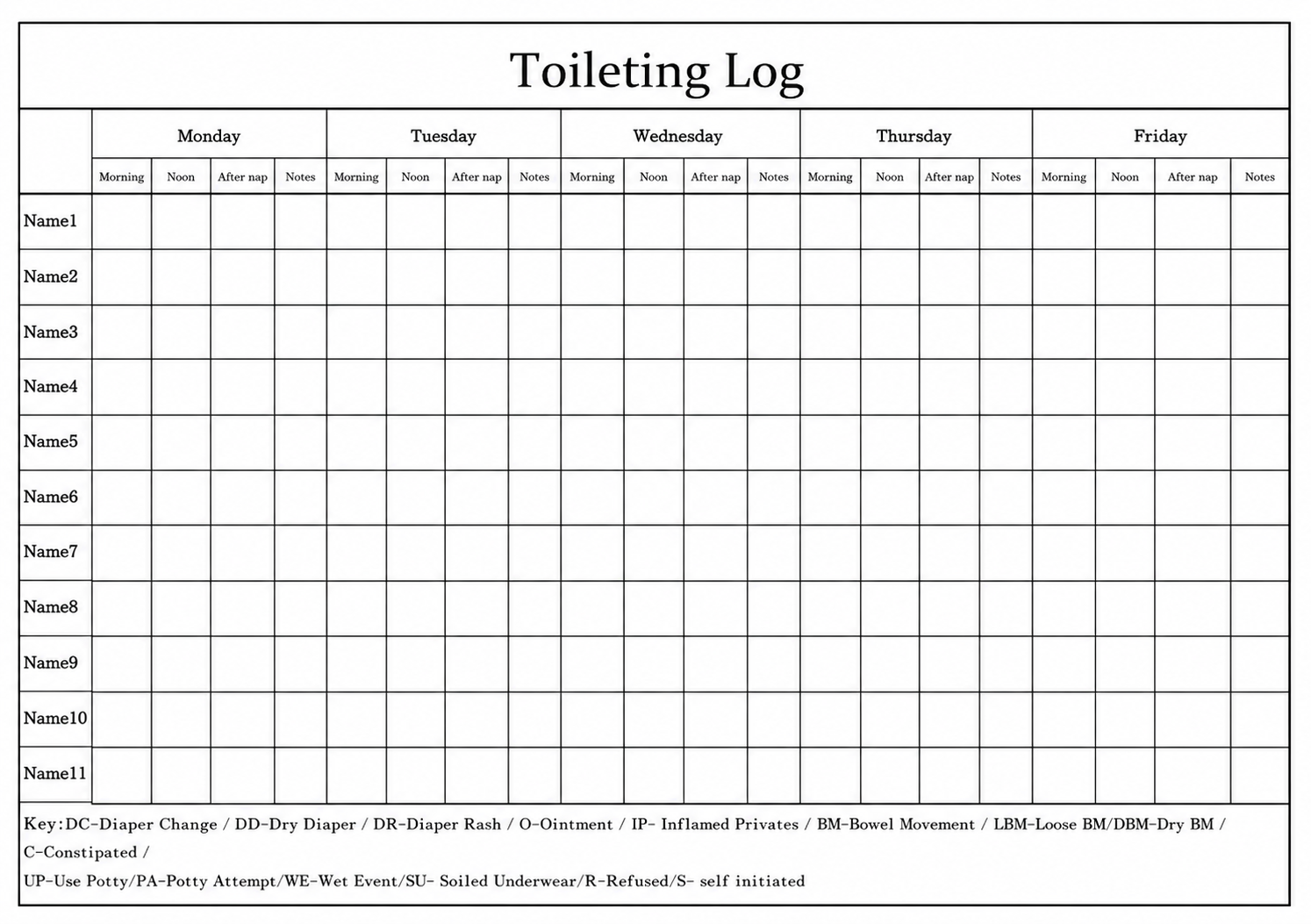
In an Infant Community classroom, a detailed toileting and diapering log is often posted in the bathroom to document each child’s care throughout the day, including the time of each diaper change, whether the child sat on the toilet, urinated, or had a bowel movement, and any other relevant observations.
This kind of record is useful in many ways. Teachers do not need to repeatedly ask one another who may need a diaper change or who should next be invited to use the toilet. They can simply check the log. It is also especially valuable when a regular teacher is absent and another adult steps into the classroom. The record provides continuity and helps the substitute teacher take over the children’s physical care more smoothly.
Teachers Should Not Assume Families Already Know What to Do
Teachers should never assume that parents automatically know how to support toilet learning. Many families feel uncertain, especially when this is their first child. They may not know how to prepare the bathroom, what clothing to choose, how often to invite the child, or how to respond to accidents.
Teachers need to offer practical guidance in detail—from environmental preparation to language, expectations, and emotional tone. A calm and confident teacher can do a great deal to ease parental anxiety. When parents feel calmer and trust the process, children often experience less pressure and are better able to attend to their own body signals. This can become a healthy cycle, and the teacher often helps set that cycle in motion.
Begin at Home When Possible
I often recommend that the first day of daytime toilet learning—the day the child stops wearing a diaper while awake and begins wearing cotton underwear—take place at home. Home is usually where the child feels most secure and relaxed. Beginning there can reduce anxiety, embarrassment, and the stress of adjusting to a new routine in a public setting.
A weekend is often ideal. Families might begin on a Saturday and remain at home with the child for two days, avoiding travel, visitors, or major outings. A long weekend or school holiday may be even more helpful. Once toilet learning has begun at home, I ask families to update me. They may share:
how many times the child urinated in the toilet;
how many toileting accidents occurred;
whether the child was willing to sit;
whether the child showed awareness before or after urinating;
how the adults responded;
and whether the child appeared calm, resistant, curious, or distressed.
Based on the child’s experience at home, we can continue supporting the process at school. Some children reach the second stage after only a few days or a week: they can successfully urinate or have a bowel movement in the toilet when invited by an adult. Having already experienced success at home may help the child return to school with greater confidence.
Once Daytime Toilet Learning Begins
Once a child begins wearing underwear during waking hours, a reasonably consistent routine can be helpful. Moving unpredictably back and forth between underwear and diapers may make it more difficult for some children to understand what is expected. However, this does not mean that diapers or pull-ups must disappear entirely. Daytime bladder control, nap dryness, and nighttime dryness do not necessarily develop at the same time.
A child may wear underwear while awake and continue using a diaper or pull-up:
during naps;
overnight;
during unusually long travel;
during illness;
during major transitions;
or for medical, sensory, or developmental reasons.
Families may have practical concerns, such as a long ride home from school. In that case, helpful strategies include inviting the child to use the toilet before departure, carrying extra clothing, and stopping to change the child when safely possible. If an accident occurs, adults should respond calmly.
If toilet learning begins to cause significant physical or emotional distress, intense resistance, repeated withholding, or ongoing conflict, it may be appropriate to pause. Pausing is not failure; it is an observation-based decision to reduce pressure while continuing to support body awareness, dressing, handwashing, and self-care.
Case Study 1: A Child Who Needed More Time
I once worked with a child who transferred from an Infant Community classroom at another campus. She was two years old and had already begun toilet learning at her previous school. However, she was urinating and having bowel movements in her clothing every day. She showed little awareness when her clothing was wet or soiled and continued playing. She was not interested in sitting on the toilet and did not yet appear to have reliable bladder and bowel control.
Her mother was deeply worried and felt that the daily accidents were undignified for her child. After observing her carefully, I decided that continuing active toilet learning was creating more stress than growth. We paused active toilet learning and returned to pull-ups to reduce stress while continuing to support body awareness and self-care.
A year later, when she was over three and showed stronger readiness cues, we began again. This time, she became increasingly independent within about a month. Soon afterward, she moved into a Casa classroom for children approximately 2½ or 3 to 6 years old. Her new teacher initially observed some regression, which is not unusual during a major transition. Within two months, however, she was again using the toilet independently.
For context, she had been born prematurely and had a mild speech delay. She received speech therapy once a week. These factors may have influenced the pace of several developmental transitions, including toileting and moving to a new classroom.
The important lesson was not that she had failed the first time.The important lesson was that she needed more time.
Case Study 2: A Younger Child Who Was Ready
Another child moved from the Nido classroom, which serves infants from approximately three months to 15 or 18 months, into my Infant Community classroom at 18 months. She was not yet using spoken words consistently, but she communicated clearly through gestures, facial expressions, and actions.
I observed that she was very interested in the toilet. She disliked wearing a diaper, showed clear awareness of elimination, and appeared able to release urine voluntarily while sitting.
After her separation anxiety had eased and she had adjusted to the new classroom, we began toilet learning. By 21 months, she had reached the third stage. She recognized when she needed to urinate and moved toward the bathroom independently. Because she was still very young, she needed adult help with some practical steps. Tight clothing was difficult for her to manage, and because of her height, she sometimes needed physical support when climbing onto the child-sized toilet.
Her example illustrates an important distinction:
Readiness does not require advanced spoken language or complete physical independence. A child may be developmentally ready for toilet learning while still needing help with clothing, balance, or communication.
Children Should Not Be Compared
These two children were very different. One needed to pause and begin again later, while the other was ready at a much younger age. Neither child’s experience should be used as a standard for another child.
Beginning at 2½ or even 3 years old can be entirely appropriate. Starting earlier is not automatically better. When toilet learning begins before a child is physically or emotionally prepared, repeated frustration may create resistance and extend the process unnecessarily. Parents may become anxious, and that anxiety may affect the tone of their interactions with the child.
The goal is not to begin as early as possible. The goal is to begin when the child is ready.
Recognizing Voluntary Release
When a child has begun experimenting with sitting on the toilet, adults may sometimes observe an important ability: the voluntary release of urine.
In my classroom experience, voluntary release sometimes appears suddenly after a period of observation and practice. However, development varies widely. For some children, it seems almost as though they have discovered how to coordinate a new action. After one or two successful experiences, the process becomes easier to repeat. For others, bladder fullness is clearly felt, but voluntary release remains difficult. Persistent withholding, pain, or difficulty releasing urine should be discussed with the child’s pediatric healthcare provider.
Case Study 3: A Sudden Moment of Recognition
I once worked with a child who was already past her third birthday when she experienced what appeared to be a sudden breakthrough. Her language, motor control, concentration, and self-care skills were developing well. She appeared aware when her bladder was full, but she sometimes had difficulty releasing urine while sitting on the toilet.
At times, she would remain dry for an unusually long period and become visibly uncomfortable. One afternoon, she became emotional while sitting on the toilet and unexpectedly urinated. She immediately stopped crying, looked down, and noticed what had happened. Her expression changed from distress to surprise and relief. That experience appeared to help her recognize what voluntary release felt like.
After several more successful experiences, she became much more confident. Within approximately two weeks, her toileting independence increased significantly.
Of course, this was one child’s individual experience rather than a universal physiological pattern. It would be inaccurate to conclude that crying caused her body to “unlock” the ability to urinate or that every child must experience a particular neurological switch before becoming independent in toileting. Instead, this case illustrates that toileting development is a complex and highly individual process influenced by many interacting factors, including bladder and bowel function, interoceptive awareness, constipation, emotional state, sensory processing, communication abilities, motor control, familiarity with the environment, and prior experience.
As adults, our role is to observe each child carefully, identify the specific barriers they may be experiencing, and provide individualized support that helps them overcome those difficulties. Respecting individual differences, rather than expecting every child to follow the same path or timetable, is essential to supporting healthy and confident toileting development.
Case Study 4: Regression During a Transition
My daughter, Mido, also experienced a slower path. For a period of time, she could sit on the toilet but did not consistently release urine there. Her daytime toilet learning therefore began later than it did for some other children. At 2 years and 8 months, she moved into a Casa classroom. The new environment created anxiety, and her toileting ability regressed. For the first several months, she came home with multiple bags of wet clothing on many days. Gradually, the situation improved. Her teachers remained patient and respectful. As she adjusted to the classroom, her toileting independence returned and strengthened.
Regression during a transition does not mean that previous learning has disappeared. It may simply mean that the child’s attention and emotional energy are being used to adapt to a new environment.
How Do We Know Whether a Child Is Ready?
So how can we tell whether a child is truly ready to begin toilet learning? The answer lies in one of the Montessori teacher’s most powerful tools: observation.
There are three key signs that a child may be ready.
First, the intervals between wet diapers become longer—for example, increasing from every hour to every two or three hours—or the child remains dry throughout a two-hour nap. These changes suggest that bladder capacity and control have developed significantly. As a result, when the diaper is removed, accidents are less likely to happen so frequently that the child becomes discouraged.
Second, the child shows an interest in sitting on the toilet. At home or in the classroom, adults can allow the child to observe appropriate toileting routines and invite them to participate. A child who is eager to imitate others may be showing an important sign of readiness.
Third, the child begins to demonstrate some control over the bladder sphincter muscles. When this ability is observed, toilet learning can begin right away. However, if this control has not yet become obvious, but the first two signs are present and the child is over two years old, it may still be appropriate to begin a gentle trial.
The key, then, is to watch carefully for these signs and use them to determine the right time to begin. Because every child develops differently, observation should continue even after toilet learning has started. Adults need to consider how best to support the child both physically and emotionally, helping them build confidence and move toward success.
